
Sexual Abuse Protective Orders

Some important information
The Oregon Sexual Assault Task Force is a nonprofit, and does not operate a shelter service, crisis line, or other confidential advocacy services.
We do connect and refer survivors and those trying to support survivors to appropriate local support organizations in their communities. You can find these resources here, or write our staff. Our team will connect with you during our regular business hours.
Disclaimer: Every reasonable effort has been made to ensure that the information on this page is up-to-date and accurate. If you find an error (omission, wrong number, etc), please email taskforce@oregonsatf.org or call our office at 971-410-SATF (7283).
About Sexual Abuse Protective Orders (SAPOs)
A Sexual Abuse Protective Order or “SAPO” is a court order that requires someone who sexually assaulted you to stop contacting you and stay a reasonable distance away. A SAPO lasts for five years* from the date the order is first granted by a judge. You can also file for a renewal.
*In some instances, a SAPO may be granted for life.
Qualifications for a SAPO in Oregon
1
2
3
4
Age
There is no age restriction to file a SAPO.
However, if you are younger than 12, the court will appoint a guardian ad litem to represent your interests in the court case.
The person you are filing the restraining order against must be over the age of 18.
Relationship
The respondent cannot be:
Your spouse or former spouse
An adult related to you by blood, adoption, or marriage*
A former sexual partner (within the last 2 years)*
The other parent of your child
A person you are or were living with and having sexual relations with
Someone who is already prohibited from contacting you (for instance: by another restraining order or a criminal No Contact order)
*minors may qualify for a SAPO in some instances
Abuse
There was sexual contact* between you and the respondent that you (1) did not consent to or (2) were incapable of consenting to due to age or mental impairment.
Sexual contact is defined in Oregon law under ORS 163.305. Sexual contact means:
Any touching of the sexual or other intimate parts of a person, or
causing such person to touch the sexual or other intimate parts of the actor,
for the purpose of arousing or gratifying the sexual desire of either party.
Continued Threat of Abuse
You must have a reasonable fear for your physical safety.
FAQs about Sexual Abuse Protective Orders
IF YOU ARE IN DANGER OR NEED EMERGENCY ASSISTANCE, CALL 9-1-1.
If you are looking for sexual assault survivor advocacy and other support services, please click here for a list of services near you. If you are a college student looking for resources, click here to view our Campus Reporting Options website.
This resource is not intended as legal advice. Oregon SATF is a nonprofit, and does not provide individual advocacy or legal services
-
No. There is no fee to obtain a SAPO in Oregon.
-
A petitioner is the person who requests a restraining order.
A respondent is the person the restraining order is against.
-
Forms can be found online at courts.oregon.gov, at your local courthouse, or from your local DV/SA advocacy organization. Advocates are available to help you with this process.
You can file the SAPO paperwork in the circuit court in the county where you live, where the respondent lives, or where the violence occurred.
-
No. You can use a contact address, like a PO box or a friend’s address on the paperwork, as long as the address is in Oregon.
-
The court will schedule a hearing so that a judge can review your application and verify that you meet the requirements for a SAPO. This is an ex parte hearing, which means the respondent does not get notified.
-
It will take place either the same day that you apply for the SAPO or the next business day. The judge may ask you some questions about your petition. If you do not meet all the requirements for a SAPO, the judge will dismiss your protective order. You may have other options: reach out to your local DV/SA organization for more information.
-
The order is effective as soon as the judge signs it, but it is not enforceable until the respondent is served. You can give a copy of the order to your work/school/any location from which the respondent is restrained. If they show up to that location, the employer/school/etc can give them a copy of the order, and they will have to leave the premises.
-
No. The petitioner CANNOT be the person who serves the respondent. The person who serves cannot be someone who is a party in the case. The can be almost anyone (over 18) other than the petitioner, and service by law enforcement is free. Private processors are also available, for a fee.
-
The respondent has 30 days from the date they are served to request a contested hearing.
If they do, you will receive a letter from the court with a hearing date. At that hearing, both of you will have an opportunity to bring evidence, witnesses, and tell your side of the story.
If the respondent does not request a hearing within 30 days, the order remains in effect and the respondent loses the opportunity to object.
-
You can call the police and make a report. If law enforcement shows up and they determine that the respondent did violate the SAPO, they must arrest them for the violation. The state or district attorney may or may not choose to bring charges against the respondent based on the violation.
Featured Resource
Featured Resource
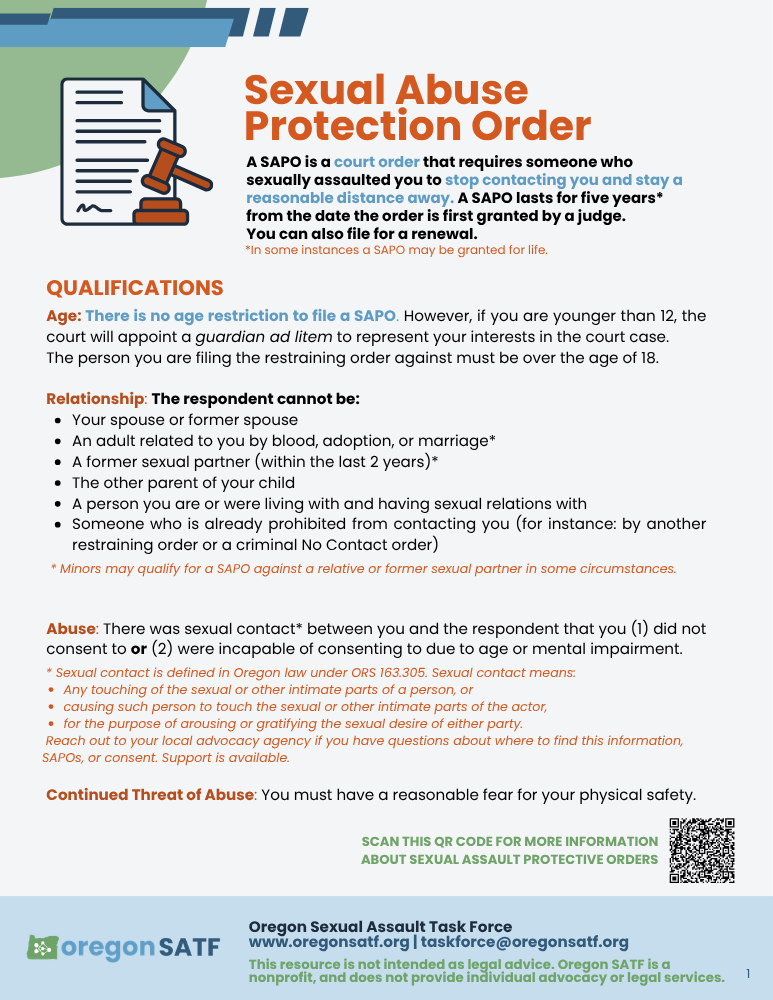
Sexual Assault Protective Order handout
This resource is intended for those seeking to learn about SAPOs, or supporting someone who has experienced harm. Created by the Oregon SATF Advocate Response Committee , this resource has all the information from this page on one easy-to-use handout.